arXiv 2026
Profiling a Frontier Agent with EBench: From Direct Control to Harness with Policy
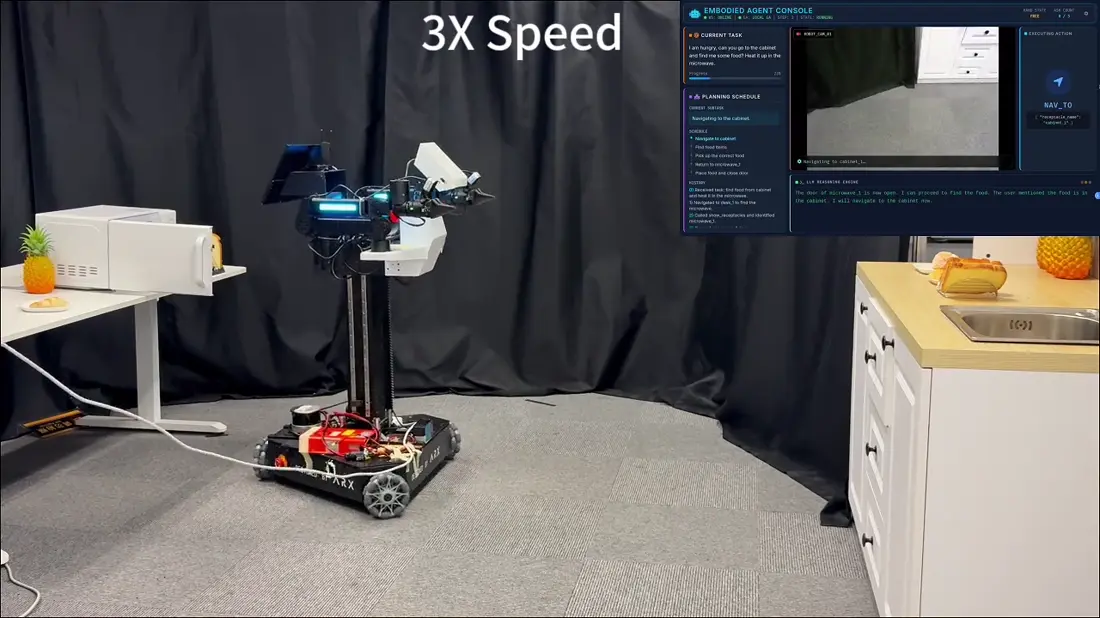
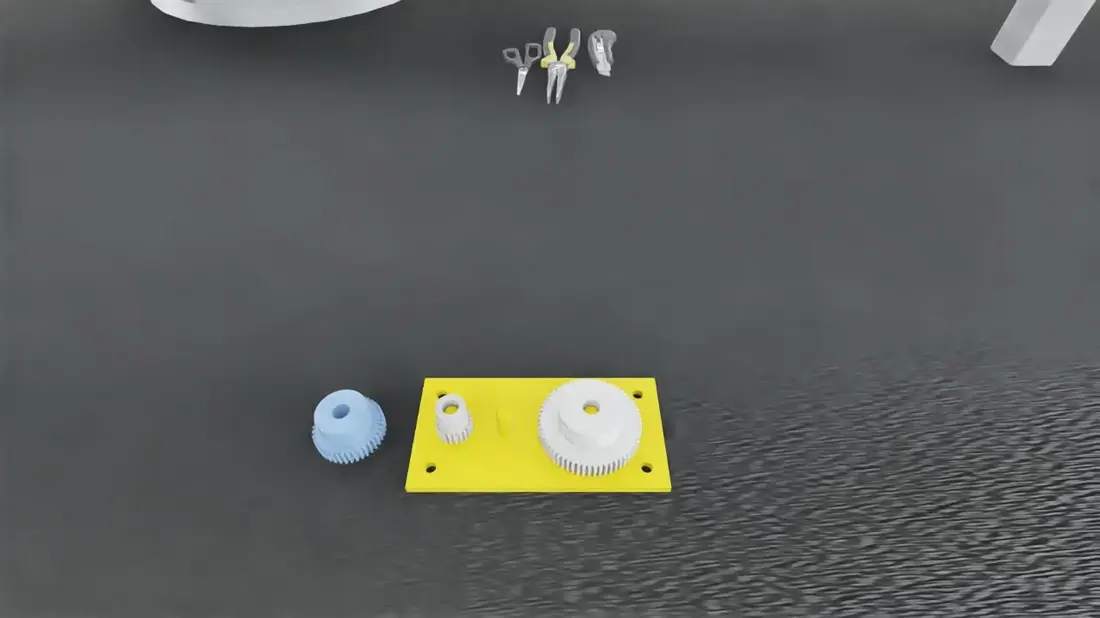
Evaluating a frontier agent on EBench under direct robot control and with a harness that can invoke post-trained robot policies.
I am a Research Engineer in Robotics at Shanghai AI Laboratory. I am interested in how offline and agentic reinforcement learning can help embodied agents learn robotic manipulation.
I received my M.Sc. in Control Science and Engineering from Shanghai Jiao Tong University in 2026, where I was advised by Prof. Jun-Guo Lu. My recent work includes embodied agent evaluation and world-action models; earlier, I worked on humanoid imitation and bipedal locomotion.
I am looking for PhD opportunities in robotics and embodied AI. Please feel free to get in touch.
Our EBench report is on arXiv, studying direct robot control and an agent harness with post-trained policies.
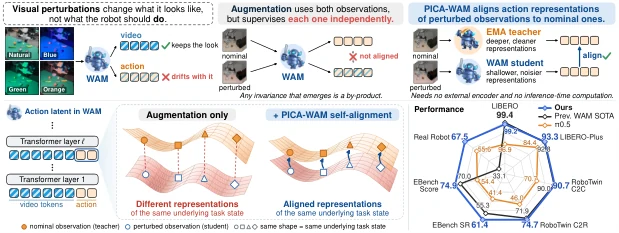
PICA-WAM is on arXiv: learning visual perturbation invariance for world action models.
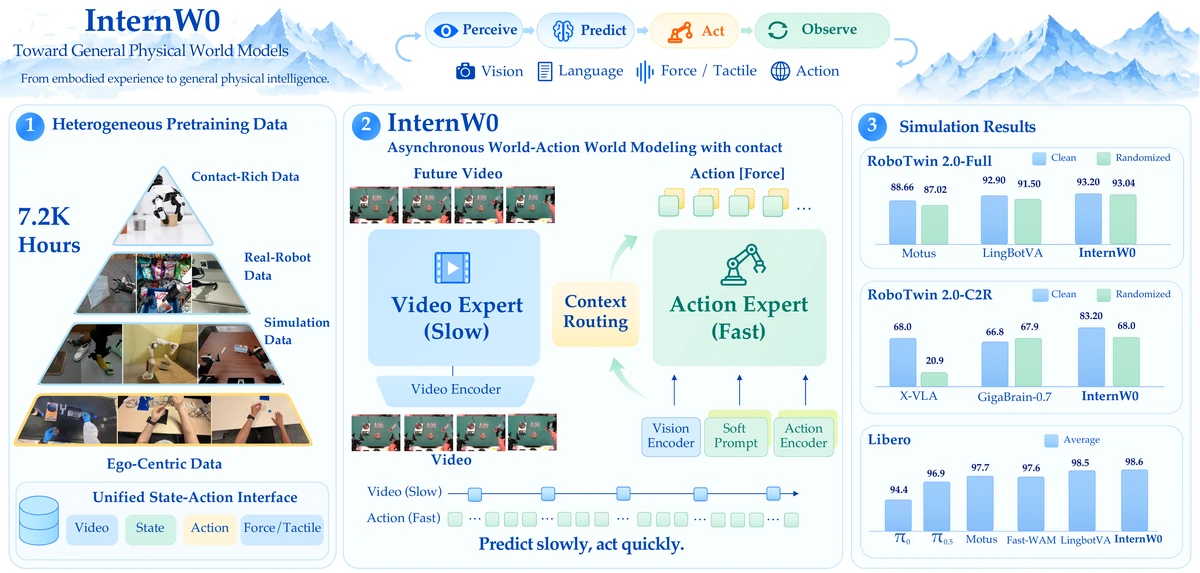
Collaborative technical reports InternW0 and InternW0-Δ are available.
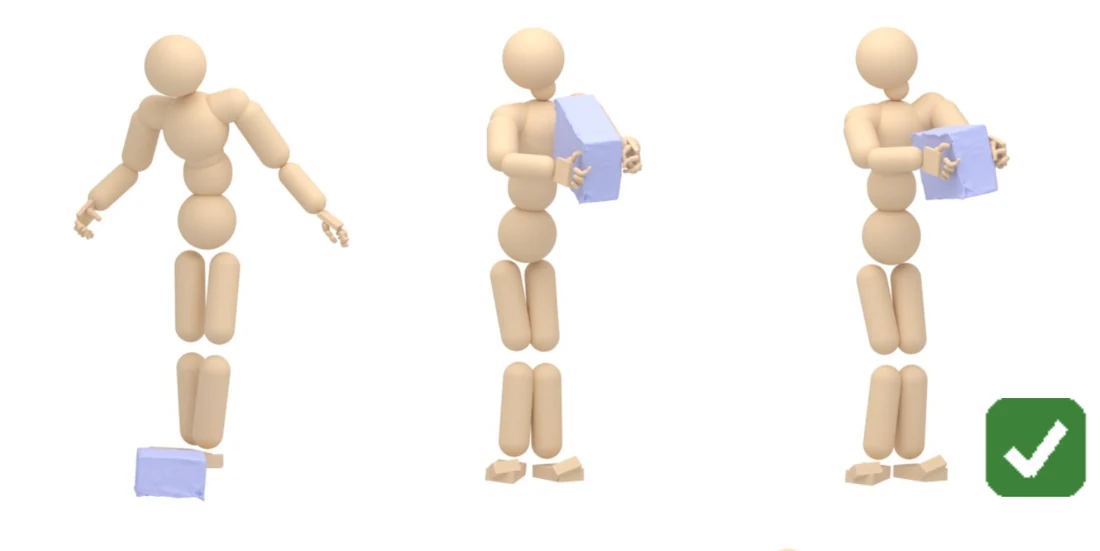
InfCoiL accepted to NeurIPS 2026 — coordinated planning and control for physical human-object interaction.
REAL accepted to ECCV 2026. Explore the paper, benchmark, and open-source code.
* Equal contribution (co-first authors).
Evaluating a frontier agent on EBench under direct robot control and with a harness that can invoke post-trained robot policies.
Cross-appearance self-alignment encourages world action models to produce consistent action representations under task-irrelevant visual changes.
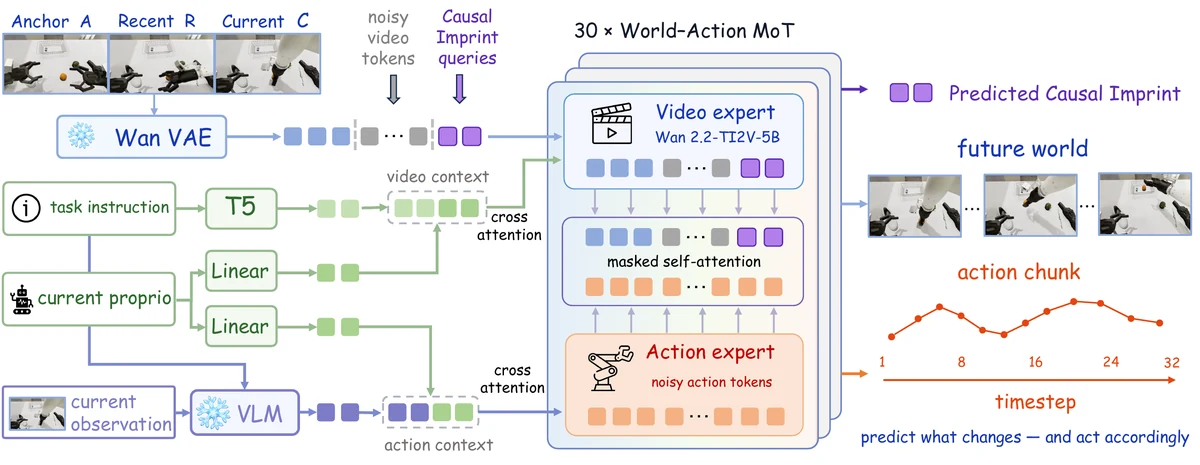
A world action model combining predictive dynamics, semantic guidance, and geometric priors, pretrained on more than 20,000 hours of open data.
An asymmetric video-action architecture couples future visual dynamics with continuous robot control, supporting asynchronous prediction and contact-aware interaction.
Accepted
A flow-matching planner and a multi-morphology controller learn together through closed-loop reinforcement learning for physical human-object interaction.
Vision-driven mobile manipulation through active exploration, visual grounding, and interactive intent disambiguation, with a shared interface for simulation and real robots.
Length-adaptive proximal policy optimization with reinforcement learning from human feedback for non-uniform UAV control.
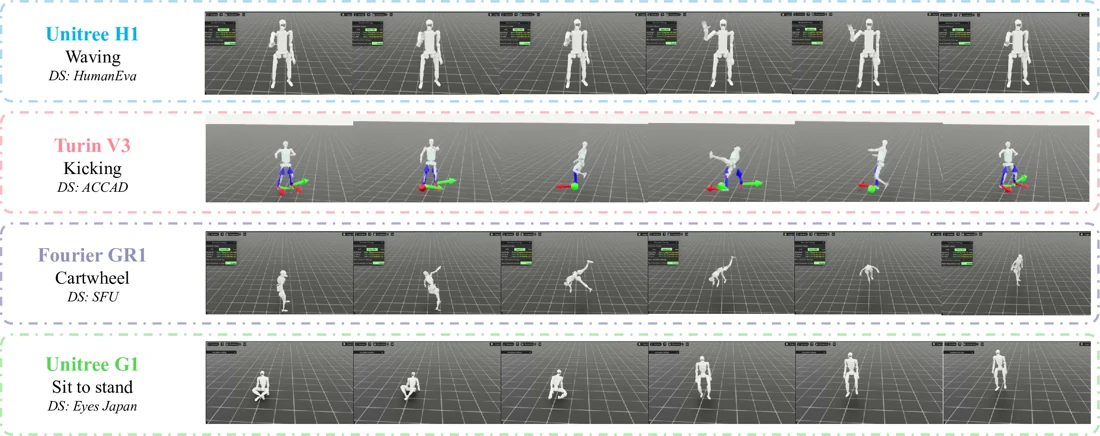
An open-source pathway from human motion to humanoid action: differentiable retargeting, DAgger-MMPPO, and an Isaac Lab training workflow.